


Lifting The Veil
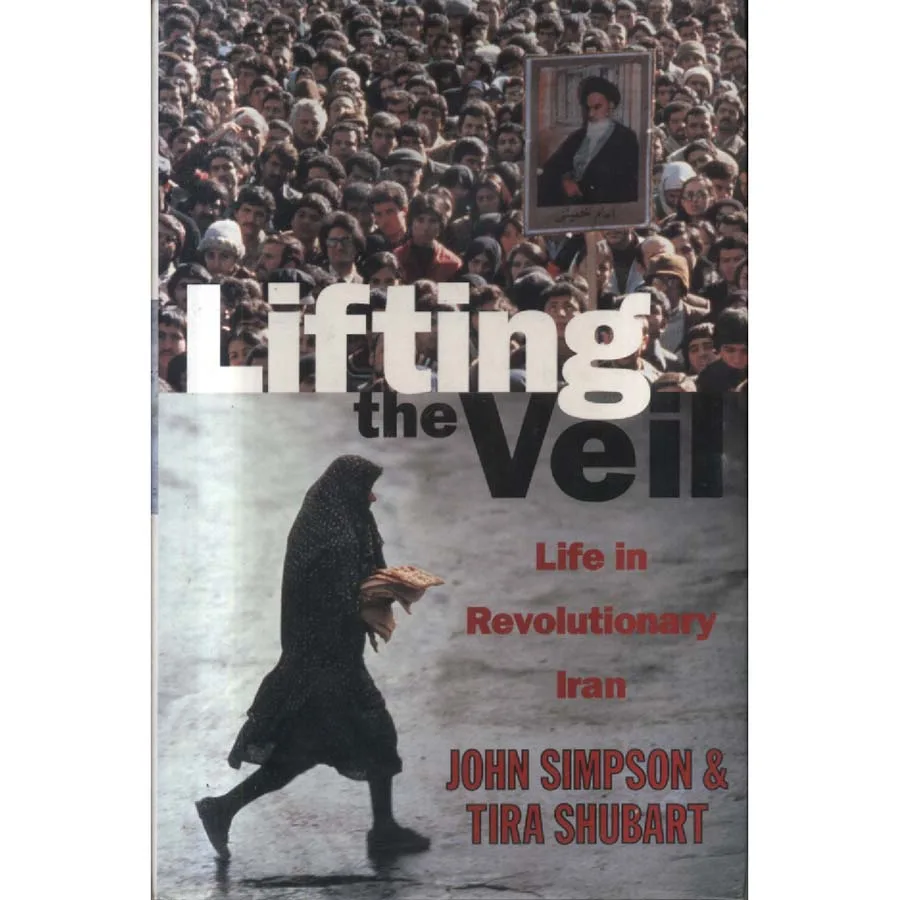
Publisher: Hodder and Stoughton
Format: Hardback
ISBN: 9780340628140
Lifting the Veil – Life in Revolutionary Iran (1995) by John Simpson and Tira Shubart
Hodder and Stoughton
ISBN: 9780340628140
Condition: Good
Iran is one of those countries that has spent decades being described from a distance by people who already know exactly what they think about it.
John Simpson and Tira Shubart’s Lifting the Veil takes the rather more demanding approach of actually going there.
Published in 1995, the book explores life in the Islamic Republic more than fifteen years after the 1979 revolution transformed Iran’s political, religious and social landscape. Simpson, best known for reporting from places where most sensible travel agents would recommend somewhere else, sets out to look beyond the familiar headlines of ayatollahs, demonstrations and diplomatic confrontation.
The result is part travel writing, part political reportage and part attempt to understand a country that rarely fits comfortably inside the explanations produced for it.
Iran after the revolution presented outsiders with an especially complicated picture.
The Shah had gone.
Ayatollah Khomeini had returned.
The monarchy had been replaced by an Islamic republic.
Then came the American hostage crisis, the Iran–Iraq War, international isolation and years of revolutionary politics.
By the mid-1990s, an entire generation had grown up inside the new system.
Simpson and Shubart wanted to know what that actually meant in everyday life.
Which turns out to be considerably more complicated than reading government slogans.
They travel through the country meeting ordinary Iranians and examining the strange mixture of religious authority, revolutionary ideology, ancient culture and ordinary human behaviour that makes up Iranian society.
Because even in a revolutionary Islamic state, people still fall in love, complain about bureaucracy, worry about money, raise children, make jokes and find inventive ways of dealing with rules they consider inconvenient.
Governments may create ideology.
Citizens still have to get through Wednesday.
The book looks at the restrictions imposed by the Islamic Republic, particularly upon women, while also exploring the ways people negotiate those restrictions in practice.
This distinction is important.
Countries rarely operate exactly as their official rulebooks suggest.
If they did, Britain would presumably be populated entirely by people reading government guidance documents and filling in forms correctly.
Iran certainly had strict regulations concerning dress, behaviour and public morality, but underneath these formal structures lay private lives that could be much more varied.
The “veil” of the title therefore works on several levels.
There is the literal veil associated with compulsory female dress after the revolution.
But there is also the figurative veil separating outside perceptions of Iran from the enormously complicated society behind them.
Simpson is particularly good at finding the gap between official appearances and lived reality.
He has spent much of his career arriving in countries where governments would prefer journalists to see one thing and discovering several others instead.
This generally involves conversations with taxi drivers.
Taxi drivers, as history has repeatedly demonstrated, possess more political intelligence than many entire diplomatic services.
The book also examines the continuing impact of the revolution itself.
Revolutions are often presented as single dramatic moments.
Crowds gather.
Governments collapse.
Flags change.
Television cameras go home.
Then everyone has to live with what happened for the next several decades.
By the 1990s, Iran had moved beyond the immediate revolutionary period, but the institutions, religious structures and cultural battles created in 1979 remained firmly in place.
There were tensions between younger and older generations.
Between religious authority and private behaviour.
Between revolutionary ideals and everyday economics.
And between Iran’s desire to maintain its own political identity and the outside world’s determination to interpret everything it did through the revolution.
There is also the enormous shadow of the Iran–Iraq War.
Eight years of fighting had left hundreds of thousands dead and deeply shaped Iranian society, politics and national identity.
For Western readers, the war can sometimes appear as a distant chapter in Middle Eastern history.
For Iranians living through the period described here, it was recent memory.
That gives the book a seriousness beneath the travelogue.
Iran is not being treated as an exotic curiosity.
It is a country carrying revolution, war, religion and modernisation simultaneously, while millions of people attempt to lead ordinary lives in the middle of all four.
Which is enough to keep any society busy.
The book also benefits from Simpson’s refusal to make Iran conveniently simple.
The government may be authoritarian and deeply conservative without every Iranian being identical to the government.
Religious belief may be sincere without every rule being universally welcomed.
Western hostility towards the regime may sometimes be justified without Western understanding of Iranian society necessarily being particularly sophisticated.
Reality insists on being awkward.
This is generally bad for slogans and excellent for books.
For readers interested in Iran, Middle Eastern politics, modern history, journalism or simply what happens when a foreign correspondent spends enough time looking behind the official version, Lifting the Veil offers a fascinating portrait of a country during a particularly important period.
It is also an interesting historical document in its own right.
Published in 1995, it captures Iran before the reformist presidency of Mohammad Khatami, before the post-9/11 geopolitical order and before another generation of conflict and protest changed international perceptions yet again.
Reading it now means seeing Iran at a specific moment rather than through hindsight alone.
This copy is in Good condition, having survived rather more peacefully than much of the political history discussed inside.
Available from Crappy Old Books, where we occasionally lift the veil on international affairs, although usually only after checking whether the book has a dust jacket.
Keep browsing: See more History books Other books by John Simpson
